The Siemens × monico case
In public bidding processes, time is not wasted all at once. It is consumed progressively, distributed in repetitive tasks, cross-validations, information searches and internal coordination that multiply throughout each procedure.
Each public tender may involve more than 40 different documents, hundreds of pages and the simultaneous participation of several internal areas. Bases, technical annexes, administrative formats, clarification meetings, guarantees, technical and economic proposals. Everything must be complete, current and submitted correctly within strict deadlines.
In this context the Offers area operates. Siemens Healthineers, which manages between 180 and 250 public tenders per year. At this volume, the main challenge is to sustain the daily operation with control and consistency, preventing the team's time from being absorbed by administrative complexity.
Where is time concentrated in a public tender
The time consumption in a tender is not concentrated in a single stage. It appears throughout the entire process cycle.
The first critical point is the base analysis. It is not a single document, but a set of files that can easily exceed the 300 or 400 pages. The technical, administrative and legal requirements are usually distributed in different annexes, which forces the team to read, reread and compare information to identify what is mandatory, what is exclusive and what requires clarification.
Then the clarification meetings. Each round introduces new answers, clarifications or modifications that impact what has already been analyzed. In real tenders, it is common to participate in more than one meeting, each with dozens of questions and answers that must be correctly incorporated into the proposal.
Putting together the proposal adds another relevant layer of work. Repetitive forms, recurring legal documentation, valid certificates, signed letters, guarantees and specific technical annexes. In medium-sized tenders, a single proposal can gather 50 different documents, all with strict formal requirements.
To this is added the coordination between internal areas: technical, legal, financial, administrative and management. Much of the time is spent validating versions, consolidating information and preparing manual reports to provide visibility on the status of the process.
The cumulative effect of repetitive work
When an organization participates in dozens or hundreds of public tenders per year, this scheme generates a clear cumulative effect. Administrative and coordination tasks absorb a significant proportion of the team's time, while the space for in-depth analysis and decision making is reduced.
Furthermore, the usual success rate in public tenders is usually between 10% and 30%. This implies that a significant part of the time invested does not translate into awarded contracts, even when the previous effort has been complete and rigorous.
In this context, optimize the use of operational time It becomes a key factor to sustain volume without increasing wear or structure.
Recover time through management end-to-end
Siemens' adoption of monico was aimed at reduce time spent on repetitive and coordination tasks, maintaining the rigor of public bidding processes.
monico is a platform public tender management that allows the process to be worked on in an end-to-end manner, connecting the base analysis, clarification meetings, documentation, monitoring and reporting within the same environment. In practice, this makes it easier to centralize information, maintain context between stages and reduce manual reprocessing.
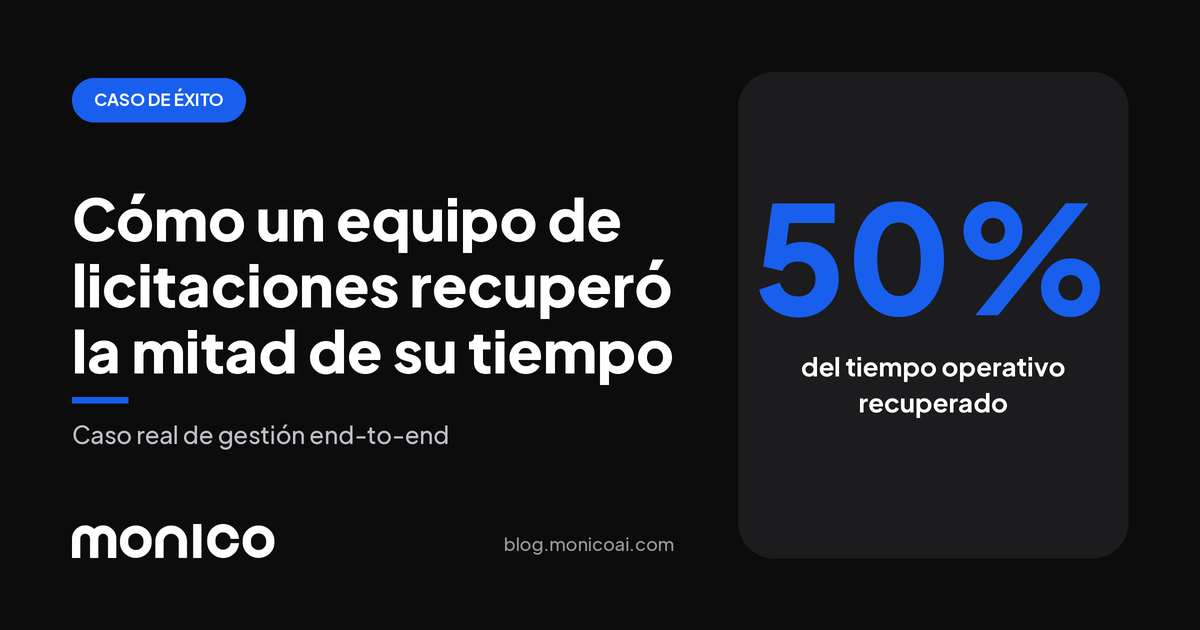
As a result, the team identified a saving up to 50% of operating time, especially in activities such as:
identification of requirements in extensive documents,
review of clarifications and their impact on the proposal,
control and assembly of recurring documentation,
preparation of internal reports.
Time as a strategic variable in public tenders
In public tenders, time directly impacts the quality of the proposal, the capacity for analysis and the consistency of the process throughout the year. Managing it better does not mean accelerating without control, but rather reduce friction and repeat less work.
By allowing the process to be worked in an integrated way and with greater visibility, monico provides a more efficient way of managing high-volume public tenders. The result is not only savings of hours, but greater control over how team time is used in one of the most demanding processes in the business.